
Strengthening Systems to Prevent and Respond to GBV: A Practical Approach
Media Contact
As professionals working with systems to make them gender sensitive we recognise that working with systems is not easy but consider it essential. Systems may include health, education, social services, justice, PRI amongst others and essentially entails working with state actors such as administrators, program managers, navigating the administrative hierarchy, frontline workers, and accountability mechanisms. We also recognise that this work entails a different approach. There is a growing recognition now about the need to work with systems to achieve deliver better, and at scale. There is also growing evidence on approaches that work to achieve an impact for large populations. One of the key learnings from the What Works [1] global programme is that collaborating with government systems is crucial to prevent gender-based violence (GBV) on a large scale. While civil society organizations (CSOs) play a vital role in innovation and advocacy, it is government systems—health, education, justice, and social services—that are responsible for large-scale service delivery. However, despite having laws, policies, and training mandates in place, many government actors still normalize violence, blame survivors, or ignore guidelines. There is often a lack of awareness, skills, and coordination across departments. A systemic, whole-of-government approach to GBV is still lacking, although the UN agencies including the WHO have developed a practical response framework.
What we have engaged in is supporting the system through capacity building, technical support such as research and data management, demonstrating a certain new service that is essential such as care for GBV survivors, introducing curricula on gender and social norms in schools at scale and medical education, amongst others.
We summarise our learnings of working with two systems to lay out what the initiatives were, what worked and what didn’t. We draw upon our experience of working with the education system through the GEMS program and the health system through the Dilaasa initiative.
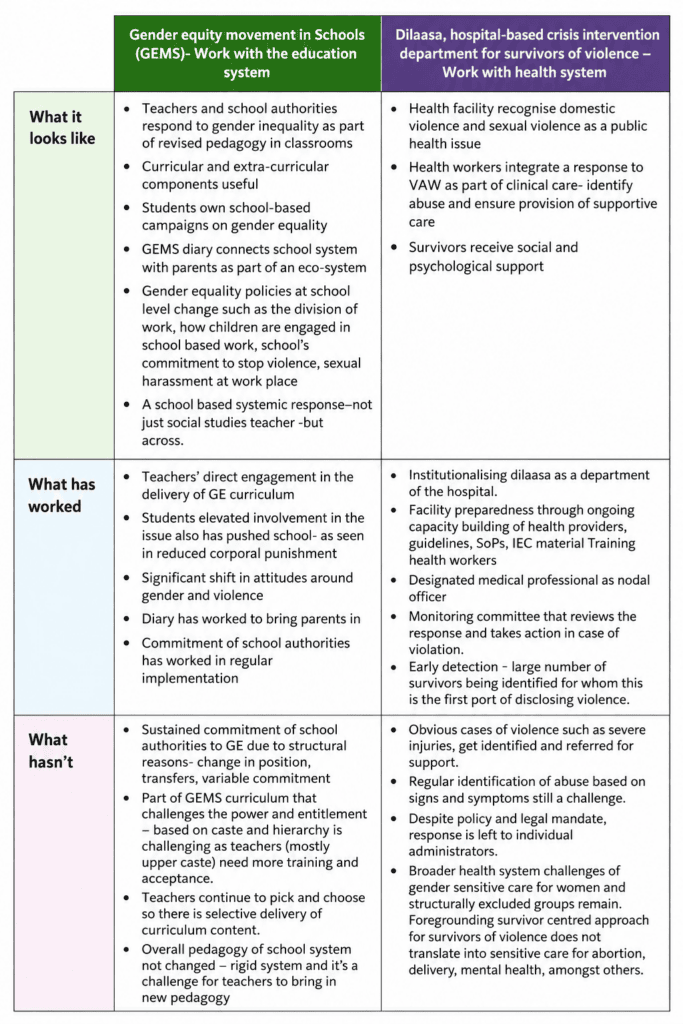
What has worked is the engagement and commitment of the system actors across the system to cultivate ownership for these initiatives and not see them as activities being driven by an external agency. The capacity building on perspective and skills was ongoing and was participatory to allow for debates and discussions. The focus on a systems approach through a clear mandate from the government system in the form of policy, SoPs and curriculum supported the initial implementation and sustained it over time.
Working with government systems can be difficult—they are hierarchical, slow to change, and often shaped by patriarchy. A continued and sustained funding support to both initiatives with a clarity on engaging with key stakeholders within the education and health system with clear objectives and outcomes sustained it. As mentioned above, what did not work is the continuity of the initiatives on its own, or gender sensitivity translating beyond the specific activity.
This kind of work requires flexibility, patience, and a long-term mindset. It also requires recognising that government staff—like teachers, nurses or police—may face violence themselves, and yet must still deliver respectful, survivor-centred care.
Some have seen this as a “soft” approach, but in reality, it’s the only way to reach large numbers of people, especially the most marginalized who depend on public services. Working with systems may take different forms- partnership or joint initiatives where the roles of the CSO and governments are carved out including funding which may be secured by the CSO for working on issues hitherto not being implemented by government, CSO taking on the implementation of a government program, CSO participating as a “watchdog” to monitor service delivery as part of social accountability. The underlying goal being to strengthen the system to deliver what it is meant to.
In Jharkhand, we take these learnings to support our joint program “Samanvay” with the JWDS to enhance the systems’ GBV prevention and response through inter departmental coordination and building data systems. By enhancing the collaboration between systems and equipping staff with the necessary tools, training, and data, we can help ensure that survivors receive the support they deserve and that violence is prevented before it occurs.