
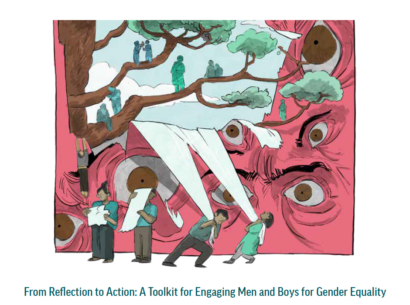
From Reflection to Action: A Toolkit for Engaging Men and Boys for Gender Equality
July 2024 - July 2026
American Jewish World Service (AJWS), developed in partnership with UNESCO. Field-testing conducted through ICRW’s MANthan programme, supported by Rohini Nilekani Philanthropies.
From Reflection to Action is a practical, evidence-based toolkit that helps organisations, practitioners, researchers and policymakers design gender-transformative programmes that engage men and boys – first as participants, and then as accountable allies in advancing gender equality. Developed by ICRW Asia in partnership with the American Jewish World Service (AJWS), it draws on decades of research and programming, the ICRW–UNESCO report Engaging Men and Boys: Pathways to Gender Equality in India (2024), a review of global resources, consultations with practitioners, and field-testing through ICRW’s MANthan programme in Jharkhand. Rooted in India’s social realities yet designed to be adapted, it pairs conceptual foundations with hands-on guidance across five areas: programme design and implementation; contextualisation and localisation; intersectionality; managing backlash and resistance; and monitoring, evaluation and learning (MEL).
WHAT ARE WE SETTING OUT TO DO?
ICRW aims to –
- Make the case for why transforming gender norms – and engaging men and boys in that work – is essential to lasting gender equality, not an optional add-on.
- Equip programme designers, practitioners and researchers with actionable principles, tools and reflective exercises to design, strengthen and review interventions through a feminist, intersectional lens.
- Reframe men and boys as participants and accountable allies, recognising that patriarchy privileges men as a group even as it imposes real costs on them.
- Offer adaptable guidance on contextualisation, intersectionality, managing backlash, and MEL that holds relevance across South Asia and the wider Global South.
WHAT METHODS ARE WE USING?
Driven by evidence: The toolkit builds on extensive secondary research, primary research with practitioners, and lessons from past initiatives. It draws on the ICRW–UNESCO report Engaging Men and Boys: A Report on Pathways to Gender Equality in India (2024), two practitioner workshops, a review of 14 global toolkits and reports, and four online consultations with organisations working on gender and masculinities.
Field-tested and strengthened: The toolkit was tested within ICRW’s MANthan programme in Jharkhand through a practice-based, iterative process – internal team orientation, formative research, the selection and training of Village Champions, village-level implementation, and ongoing review and reflection – across three villages in Jamtara blocks. Learnings from testing are woven throughout the toolkit.
Reviewed by technical experts: The toolkit was peer-reviewed by gender experts and practitioners working specifically on masculinities, to sharpen its conceptual rigour, clarity, flow and practical usability, and to ensure it is adaptable for organisations new to this work as well as those deepening existing programmes.
Structured for use, not prescription: Three guiding approaches – direct engagement and customisation; reframing men and boys as participants and accountable allies; and working across levels and with multiple stakeholders – run through five self-contained, adaptable modules, each offering guiding principles, good practices, facilitator tips, and curated resources.
DISSEMINATION
Launch with practitioners: Will be launched through a dedicated launch – a formal release, a moderated conversation, and a hands-on practitioner workshop – that positions the toolkit as a living document to be questioned, adapted and built upon in context.
Reaching three primary audiences: Program designers and practitioners; monitoring, evaluation and research experts; and the broader ecosystem of governments, donors, civil society organisations, UN agencies and community institutions.
Publications
Project Team
Sapna Kedia