

How A Gender-Smart Clean Energy Transition Is Transforming India’s Little Rann of Kutch
Media Contact
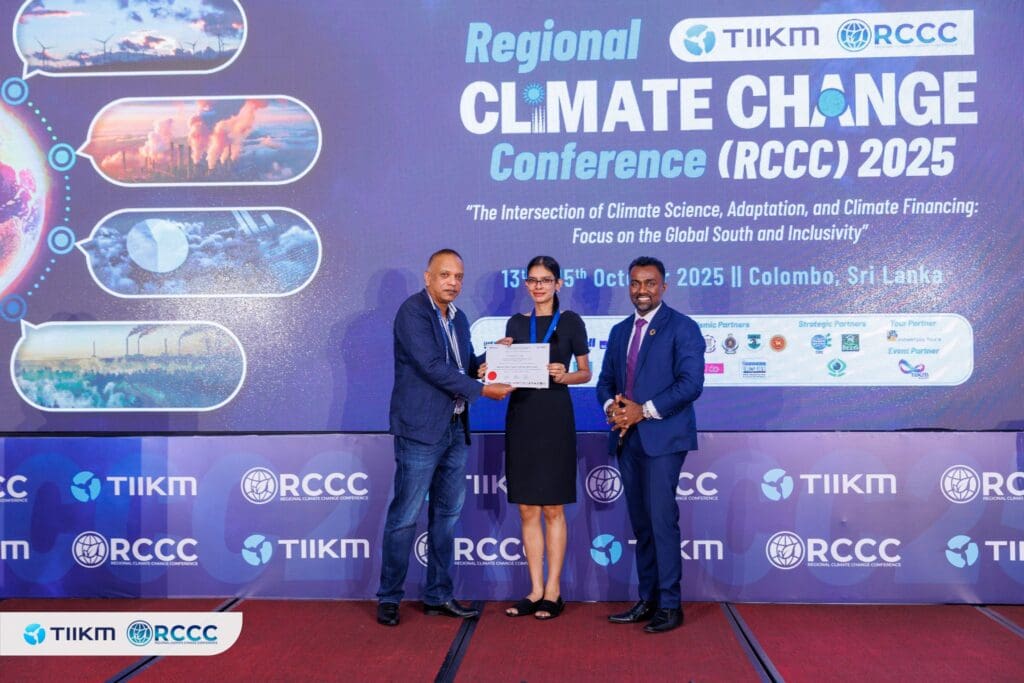
At the first Regional Climate Change Conference in Colombo last month, ICRW Asia’s Deepannita Misra helped set the tone for a powerful conversation on gender, climate resilience, and locally rooted solutions. Awarded Best Session Presenter, she showcased ICRW Asia and SEWA’s joint study, Solar Pumps and Shared Power: Gender-transformative Climate Action in the Little Rann of Kutch. Her presentation highlighted how clean energy transitions, built with a gender lens, can strengthen women’s economic agency, collective leadership, and long-term climate resilience.
I sat down with Deepannita to unpack the work behind the award, the insights that shaped her session, and what this recognition means for advancing gender-equitable climate action.
- What does this recognition mean to you and to ICRW’s work on climate action?
This recognition means a lot. For me, it is encouraging to see gender equity and justice acknowledged as central to climate change. Our study in Gujarat’s Little Rann of Kutch showed how women’s agency, leadership, and collective action can transform climate adaptation from a mere technological shift, such as transitioning to solar-powered salt farming, into a process of social and economic empowerment.
This recognition also highlights ICRW’s commitment to bringing a rigorous, evidence-driven gender lens to the climate discourse, which is an area often dominated by technical or sectoral perspectives. It reaffirms the importance of centering women’s experiences, knowledge, and leadership in building climate-resilient economies and shows that our intersectional, evidence-based approach resonates with practitioners and policymakers globally.
It also motivates us to continue advancing research that positions women not as passive beneficiaries but as active agents shaping inclusive and sustainable climate solutions.
- The Global South is often at the frontline of climate impacts, yet its voices are underrepresented in global dialogues. How can researchers from the Global South reshape the global climate narrative?
Researchers from the Global South play a crucial role in shaping how climate action is understood and led. We are the ones witnessing firsthand how communities adapt, innovate, and sustain themselves despite rising climate risks, and often with minimal resources.
Yet global climate research and funding ecosystems are evolving, and a greater balance between global and local leadership would make climate research more inclusive and effective.
By generating evidence rooted in context and bringing global debates closer to lived realities and local knowledge systems, whether it’s women farmers managing water scarcity or indigenous groups restoring ecosystems, we begin to shift the story from one of ‘vulnerability’ to one of agency and leadership.
From my perspective, it’s not just about informing policy; it is about redefining whose voices and experiences shape the global climate agenda and ensuring that climate solutions emerge from collaboration rather than prescription.
- Why is it critical to center women’s voices and lived experiences in climate solutions and adaptation efforts?
Women’s leadership in managing natural resource management is not new. For generations, women have passed on their skills in water, forest, energy, and biodiversity management, and have undertaken leadership roles in the household and the community. When given equitable access to opportunities, financing, and technology, women can problem-solve, innovate, and lead effectively.
When women’s voices are centered, climate solutions become more grounded in social and economic realities. Research consistently shows that when women are meaningfully involved in resource management, conservation, and adaptation outcomes improve. Yet, globally, women are not at the forefront of land and asset ownership, and most climate plans still don’t fully integrate gender and equity into their design.
Women’s lived experiences make clear that overlapping inequalities, such as access to water, land, credit, or technology, determine ‘who’ can adapt and ‘how’. Hence, listening to and investing in women’s leadership isn’t just the right thing to do; it is what makes climate action effective, equitable, and enduring.
- Evidence generation is at the heart of ICRW’s approach. How can gender-responsive evidence help drive more equitable climate policies?
Gender-responsive evidence reveals that climate impacts and the benefits of climate programs are distributed unequally. These insights allow policymakers to design interventions that are not only effective but also equitable.
For example, data from India’s renewable energy programs show that women’s participation increases dramatically when access to credit, skills, and training are built into the design. By capturing women’s contributions, constraints, and leadership in climate action, such evidence moves the needle from tokenistic inclusion to systemic transformation, ensuring that policies are grounded in realities rather than assumptions.
Ultimately, grounded, gender-responsive evidence bridges the gap between global ambition and local reality, making climate policy both inclusive and transformative.
- What gaps still exist in the current climate and gender research landscape?
There’s still a significant gap in how we connect gender and climate outcomes over time. Most research remains short-term and project-specific, so we rarely capture how interventions actually transform lives or systems in the long run.
We also need more intersectional work–examining how gender intersects with class, caste, geography, and livelihoods. Although local women’s knowledge is at the heart of much of the adaptation happening today, it remains underrepresented in formal research and policy spaces. Finally, women are often seen as beneficiaries rather than stakeholders in planning and decision-making. Bridging the gaps between data and lived experience, and between local realities and global policy, will make climate action truly inclusive and effective.