
Asia

Measurement, Learning & Evaluation of the Urban Health Initiative

Measurement, Learning & Evaluation of the Urban Health Initiative
Uttar Pradesh, India, Baseline Survey 2010

Priya Nanda, Pranita Achyut, Anurag Mishra, Lisa Calhoun
2011

The Measurement, Learning & Evaluation (MLE) project is the evaluation component of the Urban Reproductive Health Initiative, a multi-country program in India, Kenya, Nigeria and Senegal that aims to improve the health of the urban poor. A key objective of the project is to undertake a rigorous impact evaluation of the country programs, identifying the most effective and cost-efficient programmatic approaches to improving contraceptive use among the urban poor.

This report presents baseline survey results from samples in six cities in Uttar Pradesh, India. These findings provide an in-depth, quantitative examination of the factors that influence contraceptive use and fertility. Data from this survey can help guide program planners and policymakers as they determine which policies and programs are likely to lead to the desired reproductive health outcomes.

The MLE project is implemented by the University of North Carolina’s Carolina Population Center, in collaboration with African Population and Health Research Center and the International Center for Research on Women. For more information about the MLE project, visit www.urbanreproductivehealth.org.

(1.49 MB)

We encourage the use and dissemination of our publications for non-commercial, educational purposes. Portions may be reproduced with acknowledgment to the International Center for Research on Women (ICRW). For questions, please contact publications@icrw.org; or (202) 797-0007.

Terms and Conditions »

An Action Guide for Gender Equality in National HIV Plans

An Action Guide for Gender Equality in National HIV Plans
Catalyzing Change through Evidence-based Advocacy

Reshma Trasi, Katherine Fritz, Katya Burns, Zayid Douglas
2011

National governments must design policies that support gender-responsive HIV programs. ICRW developed and tested a replicable process through which countries could build and sustain gender-responsive national plans for a more effective HIV response. This publication describes how the process unfolded in two countries, Cambodia and Uganda, and shares lessons that can inform similar efforts. It describes how to identify partners and collaborators, conduct a gender assessment of the current HIV policy and program environment, use the assessment findings to develop recommendations, create communications and advocacy plans to feed the recommendations into policy formation, and plan for sustained national gender and HIV efforts.

(618.43 KB)

We encourage the use and dissemination of our publications for non-commercial, educational purposes. Portions may be reproduced with acknowledgment to the International Center for Research on Women (ICRW). For questions, please contact publications@icrw.org; or (202) 797-0007.

Terms and Conditions »

Understanding and Challenging Stigma Toward Injecting Drug Users and HIV in Vietnam

Understanding and Challenging Stigma Toward Injecting Drug Users and HIV in Vietnam
Toolkit for Action

Dr. Khuat Thu Hong, Nguyen Thi Van Anh, Khuat Thi Hai Oanh, Ross Kidd, Laura Brady, Laura Nyblade, Anne Stangl
2011

Vietnam has a growing problem of illegal drug use and addiction, which has a serious impact on the health and well-being of individuals, families, and communities. This problem is closely linked to HIV transmission, and fear of and stigma toward drug users is further fueling the HIV epidemic. Since 2000 the Vietnamese government and civil society have increased their efforts to address stigma and discrimination toward IDUs, as well as the vulnerability of IDUs to HIV. However, in reality, the stigma against IDUs persists and is still widely prevalent in many places, creating barrier for HIV/AIDS prevention program.

(3.85 MB)

We encourage the use and dissemination of our publications for non-commercial, educational purposes. Portions may be reproduced with acknowledgment to the International Center for Research on Women (ICRW). For questions, please contact publications@icrw.org; or (202) 797-0007.

Terms and Conditions »

Gap Inc.’s P.A.C.E. Program Recognized by Former President Clinton

Recognition at Clinton Global Initiative as an Exemplary Approach to Women's Economic Empowerment
Wed, 09/21/2011

San Francisco, CA – September 21, 2011 – (GPS) –Today former President Bill Clinton recognized Gap Inc. for its commitment and model approach to addressing challenges in Economic Empowerment through the Personal Advancement & Career Enhancement (P.A.C.E.) program. The recognition took place during Wednesday’s closing plenary of the Clinton Global Initiative, held in New York City. Bob Fisher, son of Gap Inc. founders Doris and Don Fisher and a Gap Inc. Board Member, accepted the honor on behalf of the company.

P.A.C.E. is a comprehensive workplace education program that provides life skills and technical training for female garment workers, and is currently implemented in six countries: Bangladesh, Cambodia, China, India, Sri Lanka and Vietnam. The program asks both workers and management in garment factories to view the welfare, potential, and success of female line workers as keys to business success.
“We are deeply honored by this recognition. Investing in improving women’s lives is a natural fit for Gap Inc. and our company values,” said Bob Fisher. “The program is innovative, scalable and sustainable. Thousands of women across six countries have already participated.”

Launched in 2007, Gap Inc.’s P.A.C.E. program creates opportunities for women to advance in their careers and personal lives. The garment industry is one of the world’s largest employers of low-skilled women workers. Despite their large numbers in the workforce, relatively few female garment workers advance to management positions, as many do not have access to the education and training that will propel their professional advancement. Research shows that P.A.C.E. graduates are more productive, have lower rates of absenteeism, and advance faster in the workplace than factory workers who do not participate in the program. Not only do the women participating benefit from the program, but the factories also benefit by developing a more skilled and reliable workforce.

P.A.C.E. was designed and developed in partnership with Swasti Health Resources and the International Center for Research on Women (ICRW). CARE International is a key implementing partner. Gap Inc.’s vendor partners also play a critical role. One of these vendors in India that employs more than 60,000 workers has committed to extending P.A.C.E. to all workers by the year 2020. To date, more than 7,500 female garment workers have participated in the program.

“Education of female garment workers is a distinct way our company can support positive, lasting benefits for workers and their communities. Our deep knowledge of the apparel world, our partnerships with manufacturing vendors and local NGOs have allowed us to help make meaningful impact on the lives of thousands of women,” said Gap Inc. Chairman and CEO, Glenn Murphy.

Media Contact: 
Angela Leung Wasmer, Gap Inc. 415.427.2577
Mission Statement: 

About Gap Inc.
Gap Inc. is a leading global specialty retailer offering clothing, accessories, and personal care products for men, women, children, and babies under the Gap, Banana Republic, Old Navy, Piperlime, and Athleta
brands. Fiscal year 2010 net sales were $14.7 billion. Gap Inc. products are available for purchase in over 90 countries worldwide through about 3,100 company-operated stores, about 200 franchise stores, and e-commerce sites. For more information on Gap Inc.’s P.A.C.E. program and other community investments, please visit www.gapinc.com/socialresponsibility

About ICRW
ICRW's mission is to empower women, advance gender equality and fight poverty in the developing world. To accomplish this, ICRW works with partners to conduct empirical research, build capacity and advocate for evidence-based, practical ways to change policies and programs.

GEMS Campaign Guide

GEMS Campaign Guide
Gender Equity Movement in Schools (GEMS)

ICRW, CORO, TISS
2011

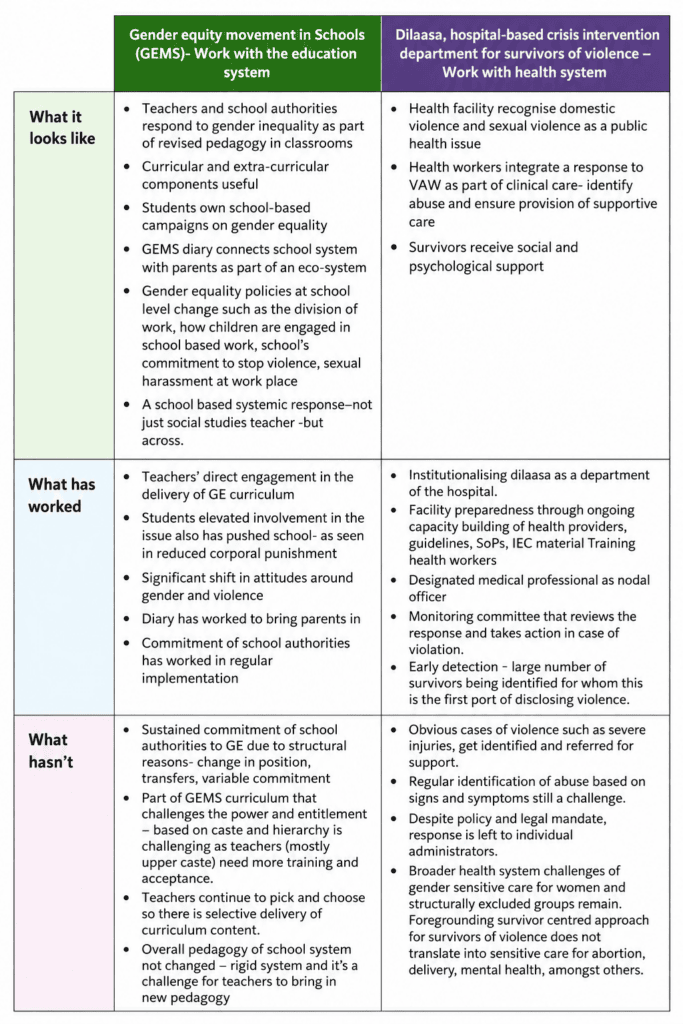
The Gender Equity Movement in Schools (GEMS) program aims to promote gender equality among adolescents in school settings by encouraging equal relationships between girls and boys, examining the social norms that define men’s and women’s roles, and questioning the use of violence. The main components of GEMS are group education activities (GEA) and a campaign. The campaign is a week-long series of events, including games, competitions, debates and short plays, aimed at reaching out to students. This campaign guide walks facilitators through steps and ideas to organize similar campaigns on gender and violence in schools.

(616.93 KB)

We encourage the use and dissemination of our publications for non-commercial, educational purposes. Portions may be reproduced with acknowledgment to the International Center for Research on Women (ICRW). For questions, please contact publications@icrw.org; or (202) 797-0007.

Terms and Conditions »

GEMS Training Manual for Facilitators

GEMS Training Manual for Facilitators
Gender Equity Movement in Schools (GEMS)

ICRW, CORO, TISS
2011

The Gender Equity Movement in Schools (GEMS) program was initiated to promote gender equality and reduce violence by engaging students in critical thinking and self-reflection. GEMS builds on successful efforts in India, such as Yari Dosti for young men and Sakhi-Saheli for young women, to foster more gender equitable attitudes and behaviors among youth, using group education activities (GEA) to engage students in the school setting. Participatory methodologies engage students in relevant interactions and reflection about key issues of gender and violence. This manual is based on the experience of conducting GEA with students. It is organized in seven modules, each corresponding to a specific theme. The GEMS experience provides evidence of a useful and feasible methodology for creating discussion around gender equality within the school setting.

(1.63 MB)

We encourage the use and dissemination of our publications for non-commercial, educational purposes. Portions may be reproduced with acknowledgment to the International Center for Research on Women (ICRW). For questions, please contact publications@icrw.org; or (202) 797-0007.

Terms and Conditions »

Former President Clinton Recognizes Gap Inc.'s P.A.C.E. Program

Clinton praises workplace program’s approach to economically advance women
Wed, 09/21/2011

Former President Clinton recognizes Gap Inc.’s P.A.C.E. program that helps female garment workers advance economically. ICRW is Gap Inc.’s global strategic and evaluation partner on the program.

Gap Inc's P.A.C.E.Gap Inc.'s Personal Advancement & Career Enhancement (P.A.C.E.) program – in which the International Center for Research on Women (ICRW) is a partner – was recognized today by former President Bill Clinton at the Clinton Global Initiative in New York as an exemplary approach to economically advancing women worldwide.

"If you want democracies to prove they can produce widespread prosperity...we have got to prove that growth can benefit everybody," Clinton said after Gap Inc. Board Member Bob Fisher presented an update on the P.A.C.E. program. "And it cannot happen unless we do more to make sure women get their fair share of it and that girls can work their way into it. That's why I really wanted this progress report today."

Gap Inc. launched P.A.C.E. in 2007 to provide female garment workers in developing countries life skills education and technical training to help them progress beyond entry-level positions. ICRW collaborated with Gap Inc. to design and evaluate initial efforts in garment factories in India and Cambodia. Today, P.A.C.E. operates in those countries as well as in Vietnam, Bangladesh, China and Sri Lanka – and ICRW continues to evaluate the program's impact globally under the leadership of Priya Nanda, group director of social and economic development at ICRW's Asia Regional Office.

Eighty percent of garment workers worldwide are women. Despite their presence in the workforce, few women advance to management positions or have the chance to build skills they need to grow professionally. P.A.C.E. attempts to change their path. To date, more than 7,500 female garment workers have participated in the program. And ICRW's research shows that the program has helped strengthen women's confidence, improve their communication skills in the workplace and encouraged them to save money regularly.

Through P.A.C.E., others – the women's families, their bosses and co-workers – also have benefited. This is key, according to Bobbi Silten, senior vice president of Gap Inc. Global Responsibility and president of Gap Foundation. Earlier this year at ICRW's first Passports to Progress discussion event, Silten stressed that it's important to the company that its investment not only advance women, but benefit their children and communities, too.

"We really believe that's the way to create sustainable programs," she said. "When everybody gets something, they keep doing it."

PACE Cambodia

Related article: Invest in a Woman, Grow the Economy

Learn more about how ICRW measures women's economic progress

Gillian Gaynair is ICRW's senior writer and editor.

Delaying Marriage for Girls in India

Delaying Marriage for Girls in India
Formative Research to Design Interventions for Changing Norms

Priya Nanda, Sonvi Kapoor, Sushmita Mukherjee, Marcy Hersh, Sharmishtha Basu and Rashi Bhargava
2011

This study examines the social norms surrounding child marriage, positive role models, community engagement and government-led efforts to prevent the practice in the states of Rajasthan and Bihar, which have some of the highest prevalence rates of early marriage in the country. Findings reveal that deeply entrenched norms are slowly changing through promising interventions to delay marriage and encourage girls’ education. The report also makes recommendations toward the development of an integrated intervention strategy to delay marriage for girls by enhancing girl’s access to education, empowerment, community mobilization, partnership with media and strengthening of law enforcement.

The study was undertaken by the International Center for Research on Women (ICRW) with the technical supervision of UNICEF India and the financial support of the European Commission.

(3.14 MB)

We encourage the use and dissemination of our publications for non-commercial, educational purposes. Portions may be reproduced with acknowledgment to the International Center for Research on Women (ICRW). For questions, please contact publications@icrw.org; or (202) 797-0007.

Terms and Conditions »

Boys and Girls Becoming Equals

School-based ICRW Program in Mumbai Shows Promising Results
Wed, 08/03/2011

New findings from a school-based ICRW program that promotes gender equality show that youth learned to be more supportive of equal relationships between women and men.

Youth who participated in a two-year Mumbai schools program that promotes gender equality transformed their attitudes towards women’s and men’s roles in society and became less tolerant of gender discrimination, according to new findings from the Gender Equity Movement in Schools (GEMS) program, implemented by the International Center for Research on Women (ICRW), Committee of Resource Organizations for Literacy (CORO) and Tata Institute of Social Sciences (TISS).

Boys and Girls Becoming EqualsThe research study took place in 45 schools, 15 of which served as the control group. Results show that over the course of the program, participating 12- to 14-year-old students grew more supportive of girls pursuing higher education and marrying later in life, and of boys and men contributing to household work. However, students’ behaviors and attitudes around reducing violence – a key component of GEMS – showed mixed results.

Overall, the findings demonstrate that the program’s approach – which uses role playing, games, debates and candid discussions on serious topics – can be successful in India’s traditionally hierarchical school setting. And the evidence comes at a critical time, as girls continue to be devalued in Indian society and their presence dwindles: The 2011 census revealed 914 girls born to every 1,000 boys – a significant decline from 927 girls in the 2001 census and the lowest since India celebrated its independence in 1947.

“Schools are unquestionably one of the most critical settings to foster support for gender equality and increase the value of the girl child,” said Ravi Verma, director of ICRW’s Asia Regional Office in New Delhi. “We need to intentionally work against these gender stereotypes that are formally and informally reinforced within the Indian school settings. GEMS is an attempt in that direction.” 

Verma will be among several speakers at an Aug. 5 and 6 meeting in Mumbai, where educators, nongovernmental organizations and government officials – including Honorable Member of Parliament Smt. Supriya Sule – will discuss how to formally incorporate the GEMS methodology into the standard curriculum and teacher trainings in Maharashtra schools. ICRW experts also will share evidence emerging from its research on the program and students who participated in GEMS will talk about their experiences. 

How GEMS works

GEMS adopts an innovative approach in an unconventional setting to tackle some of India’s deeply-ingrained social norms. 

Essentially, the program champions equal relationships between girls and boys, dissects norms that define men's and women's roles in society, and addresses different forms of violence and how to intervene. GEMS students also learn how and why their bodies change during puberty as well as talk about what makes for healthy relationships. 

They are serious topics that are addressed with sixth- and seventh-graders, led by facilitators from CORO and TISS, ICRW’s partners on the program. The education activities were held during the school day for about 45 minutes. GEMS also included a school campaign – a week-long series of events that addressed the program’s major themes. All told, GEMS reached about 8,000 students in Mumbai.

What the evidence shows

To help determine whether GEMS was making a difference, ICRW researchers developed a scale to measure students’ attitudes about gender equality as part of a questionnaire completed by students before and after the program. The scale included statements about gender roles, attributes and violence. For instance, youth were asked whether they agreed, disagreed or weren’t sure about statements such as: “Only men should work outside the home,” “Girls cannot do well in math and science” and “There are times when a woman deserves to be beaten.” 

After six months in the program, the proportion of boys and girls who had the highest gender equality scores more than doubled – a significantly greater increase than in the control group. 

Generally, boys and girls showed the greatest change in their attitude about the roles expected of and restrictions placed on women and men in society. For instance, a higher percentage of students disagreed with traditional notions that say only mothers can bathe or feed children, and that men need more care because they work harder than women. Meanwhile, over the course of the GEMS program, a significant number of students who participated in group activities and the school campaigns consistently supported the idea that girls should wait to get married. At first, most students said that girls should be at least 18 years old; over time, that increased to 21. 

“In several sessions, facilitators discussed the issue of gender discrimination, girls’ value in society and how both affect girls’ growth and development,” said Pranita Achyut, ICRW poverty, gender and HIV/AIDS specialist who oversees the GEMS program. “The findings reveal that classroom discussions helped students think about and question social norms. Facilitators also encouraged them to challenge stereotypical ideas about men and women. Those interactions clearly moved students to look at their world differently.” 

GEMS activities around violence, however, yielded mixed results. 

Experts found that physical and emotional violence at school was an integral part of young people’s lives, especially boys. For instance, 61 percent of boys and 38 percent of girls experienced physical violence in the last three months. Almost as many students admitted to carrying out violence at school, as well. 

After the first six months of the program, researchers found an increase in a proportion of boys and girls who reported physically abusing school peers in recent months. However, among those students who participated in another round of the program, the rate declined. 

“After talking to facilitators, we think that a possible explanation for the decline is that GEMS sensitized students to behaviors that they thought were normal and perhaps even playful, like hitting or pushing,” Verma said. “So in the first year of GEMS, the students became aware of their own behaviors, and in the second year, they began to develop skills to avoid resorting to violence.” 

He added that schools still need to recognize how prevalent violence is in students’ lives and develop appropriate policies to distinguish between what is playful versus what is potentially violent. 

Reaching more youth

Overall, experts say evidence from GEMS demonstrates that group activities are effective in spurring discussions in the school setting on sensitive topics related to gender equality. And, such an approach can help change young people’s attitudes and behaviors. 

Achyut said the issues covered in GEMS resonated with students because they had experienced or were experiencing them in their own lives. “The group education activities were successful because facilitators engaged and interacted with the children,” she said. “Traditionally, this does not happen in schools; students are usually expected to sit and listen to instructors, not open up and debate topics with them.” 

Now, for the lessons of GEMS to make a lasting difference as youth transition to adulthood, experts say that the program needs to be integrated throughout the Maharashtra school system.

To that end, representatives from CORO and TISS are gradually training teachers to incorporate the program into their school days. And with new funding from the MacArthur Foundation, ICRW and its partners will start introducing GEMS to 250 additional Mumbai schools, reaching upwards of 80,000 boys and girls by 2014.

“Eventually, GEMS aims to mainstream its core ideas of gender equality within the school system in a manner that would enhance respect and dignity for girls and women, and promote zero tolerance for violence,” Verma said. “We think this will ultimately result in a healthier, more economically prosperous society.” 

Gillian Gaynair is ICRW’s writer and editor.

Building Support for Gender Equality Among Young Adolescents in School

Building Support for Gender Equality Among Young Adolescents in School
Findings from Mumbai, India

ICRW, CORO, TISS
2011

Gender socialization of both boys and girls begins early, and it is important to initiate change processes at a young age to shape attitudes and transform behaviors. This research brief summaries key findings from the Gender Equity Movement in Schools program or GEMS, a school-based intervention that promotes gender equality by encouraging equal relationships between girls and boys, examining the social norms that define men’s and women’s roles, and questioning the use of violence. The GEMS experience provides evidence of a useful and feasible methodology for creating discussion around gender equality within the school setting. The findings suggest that a methodology which involves students in self-reflection has the potential to make a positive difference in attitudes and behaviors. Also, schools, as spaces for learning, have a role beyond giving knowledge to fostering support for gender equality and non-violence.

(504.03 KB)

We encourage the use and dissemination of our publications for non-commercial, educational purposes. Portions may be reproduced with acknowledgment to the International Center for Research on Women (ICRW). For questions, please contact publications@icrw.org; or (202) 797-0007.

Terms and Conditions »

Syndicate content